Google AI Overviews reach 2 billion users a month. AI is shaping how your brand gets described across ChatGPT, Gemini, Perplexity, and Claude. PRISM is the diagnostic that makes it visible, measurable, and actionable.
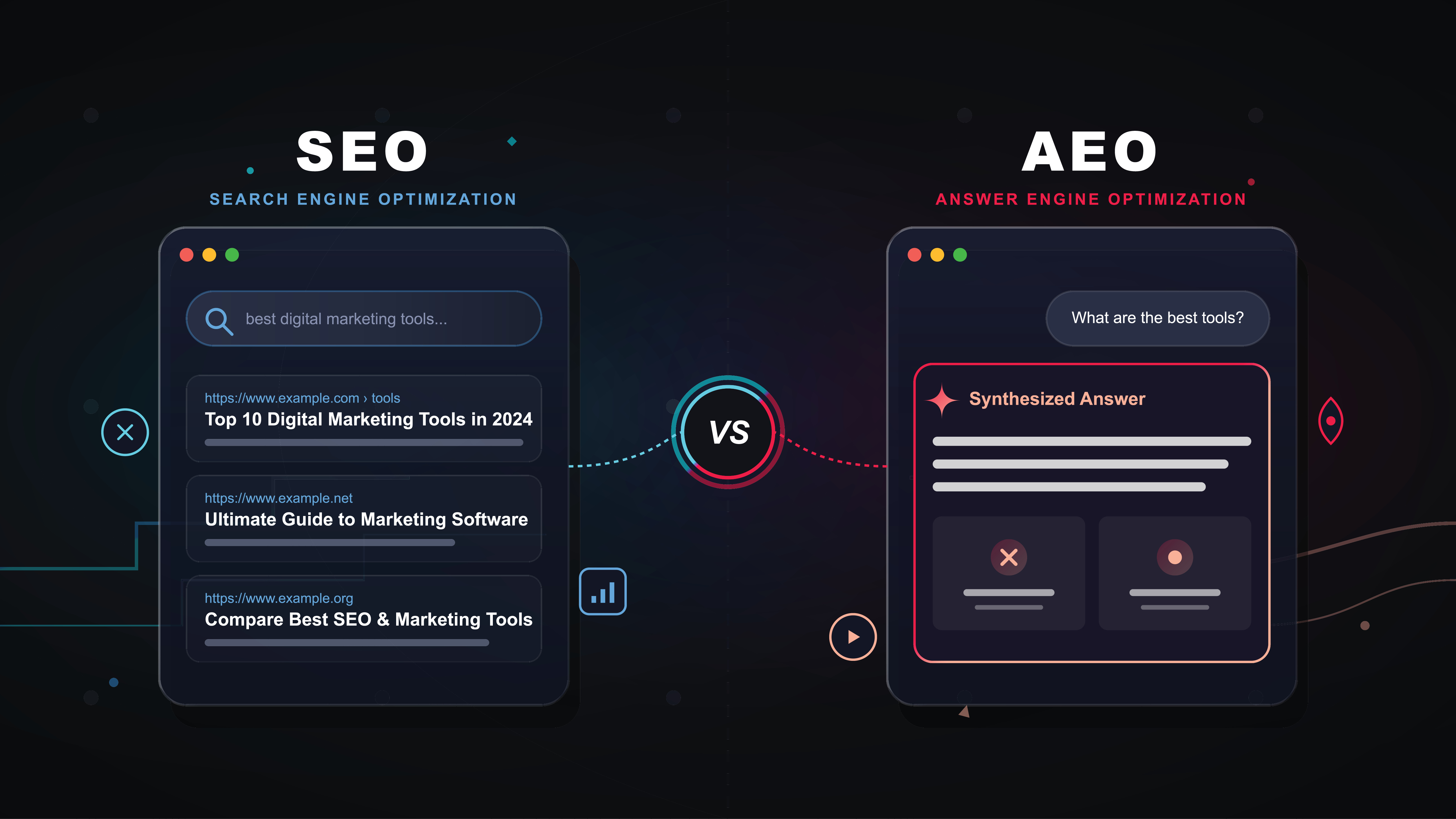
AI Overviews increasingly resolve queries inside the answer. The phenomenon has a name in industry research — zero-click search — and the traffic that used to land on your site no longer arrives.
Multi-model usage is the norm. The same buyer asks the same question across all four major platforms — and can get four different answers about your brand.
Senior practitioners told us the same thing across interviews: each release deepens the gap for organisations that haven't audited. There is no catch-up button.
These foundations form the basis of PRISM. They influence our measurements, assessments, and action recommendations. We firmly support each principle.
ChatGPT, Gemini, Perplexity and Claude each cite different sources, weight them differently, and surface different brands for the same query. Visibility is a cross-platform portfolio now — not a per-engine ranking.
A prism takes a single beam of light and reveals the spectrum hidden inside. PRISM performs a similar function for AI visibility by taking the opaque question of "how do AI agents see us?" and refracting it into five measurable dimensions that map directly to executive decisions.
The framework reflects what AI visibility actually requires, not just appearing in answers but ranking well, being described accurately, being cited by credible sources, and being technically legible to the crawlers behind every model.
Each pillar is phrased as a question a leader would actually ask — and weighted by how much it drives the outcome. Together they produce a single, comparable AI-readiness score.
We interviewed senior SEO and content leaders across consumer, B2B, and enterprise brands. Names are withheld at request; roles and organisation profiles are not. The convergence across interviews was striking.
The brands that don't audit AI visibility this year will spend the next two years trying to undo what the models learned without them. That loss compounds every release cycle — and there is no catch-up button.
We used to obsess about position one on the SERP. Now we obsess about whether the AI cites our owned media or someone else's. Half the battle is upstream of the answer — it's whether the model decided your evidence was worth reading at all.
Forward calls invite disagreement. We make these on the record, with our reasoning written down, so the next volume of this briefing can hold us to them.
.png?width=400&height=200&name=blog%20images%20(52).png)
