For leaders making decisions on AI research

You can't make AI perfect, but you can make it trustworthy

Almost nothing AI gives you has been checked, and a fabricated claim looks identical to a real one. The fix is making every claim provable. SPARK verifies every claim, so you are always confident your research is right.

The numbers behind the problem

AI doesn't tell you when it's making things up but you are making decisions based on it anyway

>69%
of specific professional research queries returned a hallucination

When Stanford tested leading models on verifiable legal questions, most answers were fabricated or wrong, and the harder the question, the worse it got.

1 in 3
companies say AI inaccuracy has already caused them a real problem

The most negative consequence organisations report from their own AI use is the AI being wrong

1600+
court cases (and counting) where someone filed AI-fabricated material

A public database of AI hallucinations in court filings has logged 1,600+ cases worldwide. It only counts the ones that produced a written ruling; most are never caught.

What we believe

Three convictions shaping how we think about AI research in 2026.

CONVICTION I

Unverified research is a liability, not a shortcut.

AI makes it easy to produce a confident-sounding report/claim, but confidence is not the same thing as evidence. A single hallucinated claim rarely fails loudly. Instead, it travels quietly into every work and decision that gets built on top of it. 

CONVICTION II

The real cost isn't a wrong answer, it's the decision and the reputation resting on it.

A hallucinated figure doesn't stay small. It flows into the market-sizing that justifies an investment, the memo that reaches the board, and the summary that goes to a regulator. By the time anyone catches it, the decision is already made, and the credibility on the line is the institution's, not the model's.

CONVICTION III

You can't make AI perfect, only accountable, and it has to hold over time.

Leaders don't need a model that's never wrong; they need work they can stand behind when a client, a regulator, or the board asks where a number came from. That means every claim carries its source and its score,  and because the facts keep moving, it's re-checked rather than left to quietly go stale between one quarter and the next.

The framework

The framework that makes the research defensible

AI research can be made accountable. Every claim is sourced, scored, and re-checkable. Once you've seen how, you can hold any AI to that same standard.

SPARK — Self-verifying, Portable, Agentic Researcher, Kit — sits on top of any AI assistant that teams are already using and turns them into a researcher that has to show its work. You bring the domain expertise and shape the recipe; it does the digging, scores every fact against its sources, and shows you where you might need to dig deeper. 

When credible sources conflict, it surfaces the tension. And because it remembers what it found, your research work compounds instead of growing stale.  Ask it what has changed a month later, and it hands back the difference instead of starting from scratch. 

S
Self-verifying
Every claim is scored before you act on it.
P
Portable
Your intelligence travels across any AI or platform.
A
Agentic
It runs the research, and the refresh, on its own.
R
Researcher
Your expertise is captured as a reusable recipe.
K
Kit
The trust infrastructure is shared, not rebuilt each time.
Five things for AI research you can trust

Don't just take the answer. Get the receipt.

Most AI hands you an answer and asks you to trust it. SPARK hands you the receipt. It holds up every claim to the light and illuminates the blind spots of AI research, turning your raw AI outputs into research you can trust.  

01
Sourcing and Provenance
“Where did this come from?”
A claim counts only if it traces to a real source retrieved during the run, then ranked by authority, from primary documentation down to anecdote. No citations were conjured from the model’s own fluency.
02
Reproducible trust scoring
“How sure are we?”
Every fact earns a score computed from source quality, corroboration, and conflict, and that score can be recomputed from a documented formula. Confidence becomes a number you can audit, not a vibe.
03
Trust tiers
“How do I read it at a glance?”

Three tiers sit next to the finding itself, so the evidence travels with the sentence. You see confidence where you read the claim, not buried in a footnote.  

04
Conflict preservation
“What if the sources disagree?”

When two credible sources contradict each other, SPARK keeps both and flags the tension rather than silently averaging them into one tidy answer. Honest uncertainty beats false consensus.

05
Refresh and change tracking
“Does it still hold?”

Research isn’t a one-time artifact. SPARK re-runs against a stored fact file and reports exactly what changed, new facts, superseded claims, fresh conflicts, so a report stays alive instead of decaying into a snapshot

SPARK in action

See the research run. Or build your own recipe.

From a single prompt to a report you can confidently share.

  • 1Type the trigger phrase."SPARK [recipe] on [topic]" is the entire instruction.
  • 2SPARK runs the research.It works through the domain-specific research strategy automatically, pulling claims and verifying their sources along the way.
  • 3Read a report you can trust.Every claim carries a marker you can open to see the evidence and confidence behind it.
  • 4Come back and ask what changedOn a refresh, SPARK compares runs and writes a delta report, so you are not starting over.

Every team researches differently. SPARK builds a recipe for all of them.

No code needed. Just describe the research domain you care about, and SPARK builds a custom recipe through a short guided conversation. Within minutes, you have a repeatable, verified research workflow tailored to your exact questions.
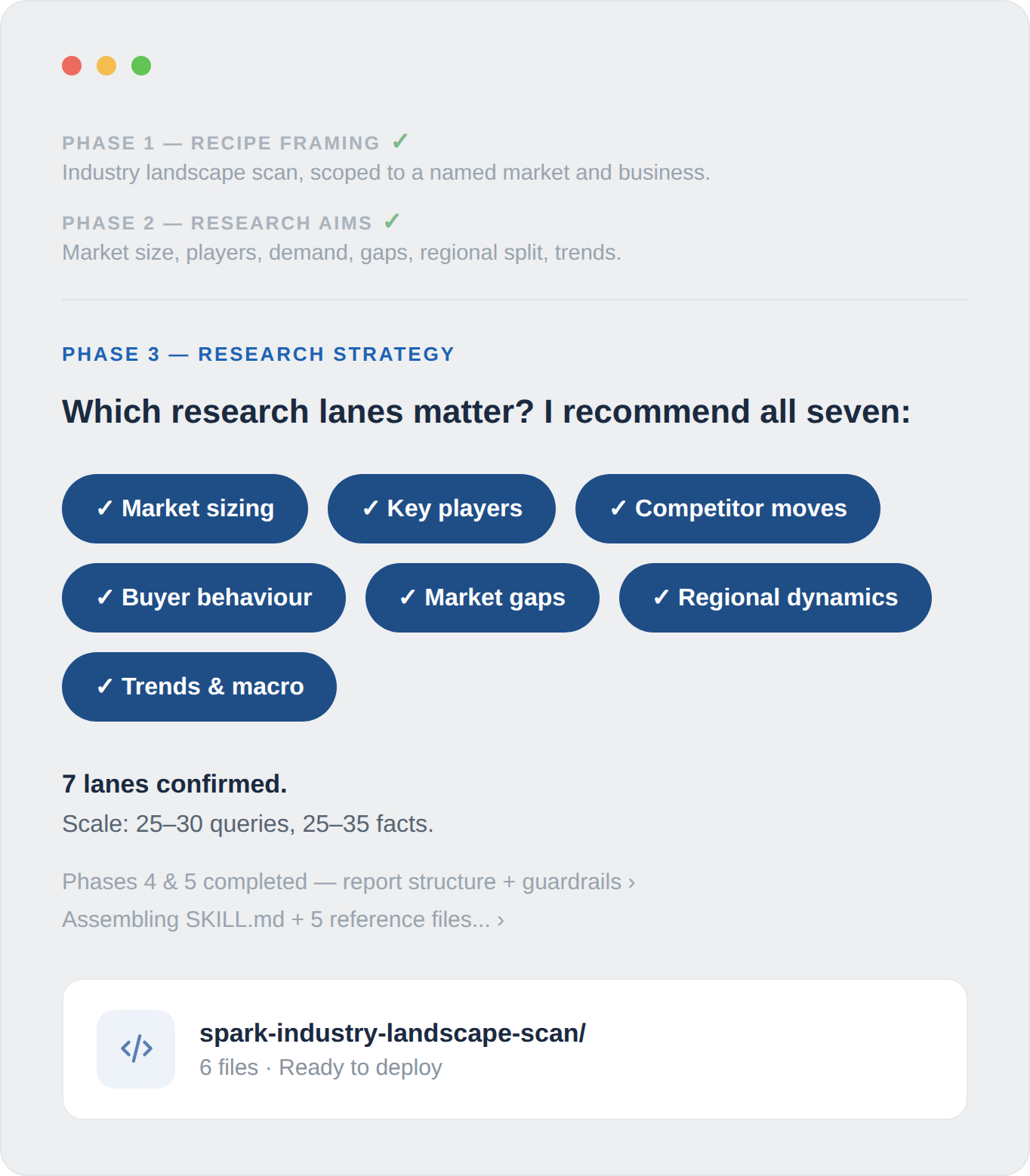

  • 1Describe what you want to research.Tell SPARK what you have in mind: "I need a recipe for evaluating vendors for our investment committee," or "I want to track regulatory changes in Southeast Asian fintech." SPARK takes it from there.
  • 2Answer a few guided questions.SPARK walks you through a handful of phases: the research focus, which evidence types matter (analyst reports, filings, practitioner forums, news), how the report should be structured, and which guardrails should apply.
  • 3SPARK assembles, tests, and delivers itThe output is a set of ready-to-use recipe file, and SPARK dry-runs it against a topic of your choice so you can see the result before committing. Every recipe you create automatically inherits SPARK's full trust infrastructure, with the same trust scoring, source tracing, fact logging, and delta reporting.
Recipe Creator
Voices from the ground

What the first people to run SPARK told us

These are early feedback from our team, who put SPARK to work on real research before anyone outside Aicadium did.

" Intuitive, one line of prompt kicks off a full deep dive. Easy to review each fact and claim individually rather than taking them on trust. I could see the time lineage, past versions of the subject and how the research had shifted."

DS
Data scientist running AI deep dives

"It stopped being a one-off report and became something I came back to. When the question stays the same but the information moves on, I refresh against the new inputs instead of rebuilding from scratch. For recurring research, that makes a whole difference."

MP
Marketing practitioner running research workflows

"The SPARK recipe creator made it easy to build a custom skill for my own domain, and refreshing it later was just as straightforward. The tap-to-select inputs kept setup simple, and I use it to answer the questions I care about."

PL
Product lead running competitive and market research
Three predictions

What we expect to be obvious by 2027  and uncomfortable to admit today.

Showing your sources stops being optional
Within 12 months

Showing your sources stops being optional

Reviewers and leadership start asking where each claim came from before signing off, whether it's a deck, a memo, or a board paper. The courts already require it: dozens of federal judges now make lawyers certify that AI output was checked, after a run of fabricated-case scandals. Boardrooms are next, and the teams logging provenance now will set the standard everyone else retrofits to.

A verified-research score joins the metrics leaders already track.
Within 18 months

A verified-research score joins the metrics leaders already track.

Teams start reporting trust and coverage the way they report budget, spend, or any other quality metric. "How verified is the intelligence we're acting on?" becomes a standing line in the business review rather than an afterthought, with a number attached.

Verification becomes a gate in the systems themselves.
Within 24 months

Verification becomes a gate in the systems themselves.

It stops being something people remember to check and becomes something the pipeline enforces. From dashboards to automated reports to personalisation engines, an unscored claim simply doesn't make it into the decision. The check moves from habit to infrastructure.

Why this matters now

Verifying our own AI research used to take hours. With SPARK, not anymore.

Without SPARK
50+ hours
per market research topic, even with AI
  • Manually verifying if each market claim is still current
  • Tracing back each source manually
  • Deciding what is reliable and what is merely plausible
  • Cross-referencing analyst estimates that disagree
  • Starting from scratch again at the next quarterly update
With SPARK
20 minutes
the same topic, verified, sourced, and tracked
  • Every fact scored and sourced automatically
  • Conflicting claims surfaced for you, never hidden
  • One trigger phrase to run the scan or refresh it later
  • Delta reports that show exactly what changed since last time
  • One verified baseline you can reuse across teams and topics

Ideas like this shape how we work at Aicadium.

Get updates about our latest AI Transformation projects.